Textbook History

Just what were we taught in biology class

Archive for the ‘Bentley Glass’ tag

Howard M. Parshley’s Translation of Simone de Beauvoir’s The Second Sex: Contrition, Sabotage or Suicide?

without comments

For most of the last 25 years, Howard M. Parshley, translator of the first English edition of Simone de Beauvoir’s The Second Sex (1953), has been cast as a saboteur of second-wave feminism. In a 1983 article, Margaret A. Simons characterized Parshley as a barely bilingual hack, ungrounded in philosophy, and bored by women’s history as evidenced by his many mistranslations of existentialist terminology and the fact that he cut the many stories of strong women present in the original. According to Simons, Parshley, a Smith College zoologist, got the gig only because Beauvoir’s American publisher, Knopf, mistakenly thought her book was about the act of sex, and Parshley had written a book on human reproduction in the early 1930s.

From The Science of Human Reproduction (1933) by Howard W. Parshley. Eugenics Publishing Company.

Parshley had his defenders, including Richard Gillman, a one-time neighbor, who in a 1988 article in the New York Times noted that Parshley, rather than hostile to Beauvoir, had encouraged Knopf to publish The Second Sex in English after reading it, in the original French, in 1949. In a note to Knopf, Parshley described the book as, “a profound and unique analysis of woman’s nature and position, eminently reasonable and witty.”

In an ironic turn, Parshley’s reputation has recently been restored, at least partially, through the publication of a new English translation of The Second Sex that was prodded into existence by Simons and other critics. The latest edition is complete and supposedly more sensitive to the original’s existentialist armature. However, at least one reviewer has admitted that the language of the new edition is literal to the detriment of felicity and coherence.

Read the rest of this entry »

  • Share/Bookmark

Race, Art and Evolution

without comments

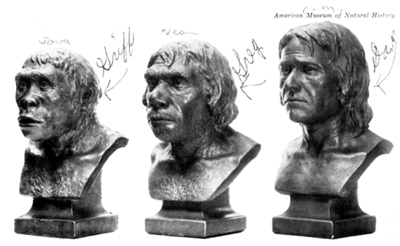
These reconstructions of Java Man (Pithecanthropus), Neanderthal Man and Cro-Magnon Man were created around 1915 by Columbia University physical anthropologist J. H. McGregor for the American Museum of Natural History. They were designed not just to impress visitors with wonders of science, but also to promote the eugenic theories of the museum’s director, Henry Fairfield Osborn. The images were reproduced in many biology textbooks to support a narrative of racial progress. Pen-wielding students often “repurposed” them to illustrate their own stories.

I’M AN APE MAN

The sculpted busts of “early man” by J. H. McGregor, and the paintings of Neanderthal flint workers and Cro-Magnon artists by Charles R. Knight, alchemized imaginary beasts of centuries past into icons of progress that carried the imprimatur of science (Moser 1998). But the narrative they presented was conflicted from the start. Created between the years 1915 and 1920 under the guidance of Henry Fairfield Osborn, director of the American Museum of Natural History, the images were designed to both celebrate scientific progress and alert visitors to the museum’s “Hall of the Age of Man” of an impending eugenic crisis. Osborn believed humans had reached an evolutionary peak in the caves of Lascaux, but that racial mixing was threatening to drag the species back (Clark 2008, Rainger 1991).

It was a downer of story, and the visiting public, or at least the white public, happily skipped past it. Instead they saw in Knight and McGregor’s images visual confirmation of their own racial, cultural and scientific superiority.

Read the rest of this entry »

  • Share/Bookmark

Written by Ronald Ladouceur

June 22nd, 2010

The Weight of the Moon or How a Single Textbook Skewed Our View of History

with 4 comments

In the 1950s and 1960s, Moon, Mann and Otto’s Modern Biology was the most popular high school biology textbook in the country, commanding upwards of 50% of the market. It was also among the most retrograde and out of date.

Scholars have criticized the book for its weak presentation of the topic of evolution. The 1956 edition is the focus of particular scorn. In that edition all references to human evolution were deleted. The publisher of the second most popular textbook, Exploring Biology, followed suit a few years later.

Had the Biological Sciences Curriculum Study (BSCS) not stepped in to stem the slide by developing new textbooks in early 1960s, would evolution have disappeared from American classrooms altogether? Read the rest of this entry »

  • Share/Bookmark

Happy Birthday, Origin

without comments

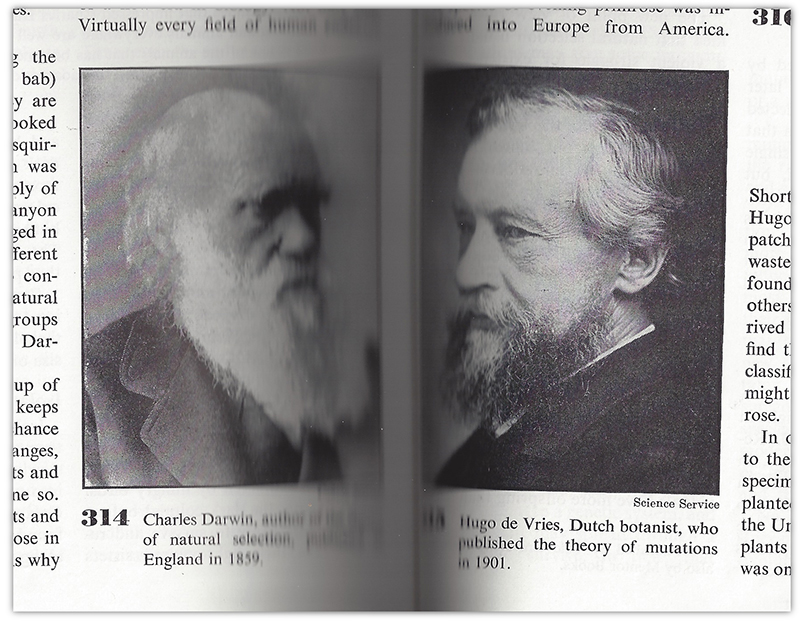
As we celebrate the 150th anniversary of the publication of Darwin’s On the Origin of Species, I thought I’d take the opportunity to note that though the image of Darwin we share today, that tired but steadfast symbol of rationality and science, dates dates back to the 1880s (see Janet Browne’s article in Isis), for the 30 years ahead of run-up to Origin’s centenary, Darwin, to borrow Peter Bowler’s term, was in eclipse.

This neat bit of ephemera was among the first attempts to restore some of Darwin’s lost luster. Published in 1956, The Darwin Reader was a “best of” (and somewhat sanitized) collection of the writings of Charles Darwin edited by two professors at the University of Michigan, Philip S. Humphrey and Marston Bates. The editors noted that hardly anybody in mid-50s was reading Darwin, professionals included. They thought a good digest would help.

I know nothing of Humphrey. But I know Bates was an amazing man. A contemporary of Rachel Carson, Bates helped popularize ecology, was a fantastic natural historian and popular author and was the person most responsible for that radically influential 1960s biology textbook, the BSCS “green version.”

If you don’t know Marston Bates, go online right now, find a used copy of The Forest and the Sea, and buy it!

  • Share/Bookmark

Written by Ronald Ladouceur

November 24th, 2009

Reform Eugenics and the Gender Bomb

without comments

Amram Scheinfeld’s 1939 You and Heredity was a bestseller, a hit not only with the general public, but also with life scientists. It was rightly lauded as an excellent layperson’s primer on the state-of-the-art in human genetics and heredity, and a serious critique of the racist, nativist and even anti-homosexual sentiments common among early eugenics supporters.

High school biology textbook authors immediately attached You and Heredity as a “further reading” to chapters on human inheritance, though they continued to mix it in with older, more hard line eugenic texts like Henry H. Goddard’s The Kallikak Family and Ellsworth Huntington’s Tomorrow’s Children.

Scheinfeld’s “breakthrough” thesis was that human behavior is governed not just by biological genes, but also by “social genes.” Scheinfeld suggested these “social genes” were much more critical to human behavior than early eugenicists thought. And that unlike beneficial biological genes, of which scientists still knew little, beneficial “social genes” were easy to identify and could be selected for simply by improving the environment.

But despite its many strengths, You and Heredity did not stray far from traditional assumptions regarding the general class distribution of “good” and “bad” genes. Though Scheinfeld believed it was impossible to know how any single individual, no matter how “badly born,” would ultimately turn out, he felt it was still critical to figure out some way of encouraging people who had good social genes, people not coincidentally like himself, to breed more and rebalance fertility rates. Read the rest of this entry »

  • Share/Bookmark

Written by Ronald Ladouceur

September 13th, 2009

Making Sense of Bentley Glass

with one comment

In its obituary, the Washington Post described Bentley Glass (1906-2005) as a “peripatetic figure in the 1950s and 1960s,” a man who seemed to be everywhere and advising everyone. In other obituaries Glass was described as “provocative” and “outspoken.” Editors of course made note of Glass’ more controversial comments, such as his 1971 statement that, “No parents will in that future time have the right to burden society with a malformed or mentally incompetent child,” a remark that the New York Times wrote, “is still regularly deplored by opponents of abortion” (Martin, 2005). Other notices, such as the one that appeared in the Bulletin of the Atomic Scientists, labeled Glass more forgivingly as a “rabble-rouser,” and noted, “Of all his pronouncements, none permeated the cultural lexicon more than his 1962 prediction that cockroaches would be the sole survivors of nuclear war” (Bernstein, 2005, p. B6; Erk, 2005, pp. 164-173; Martin, 2005; Anonymous 2005, 14).

But Audra Wolfe notes that the “approximately 90 linear feet” of archive materials stored at the American Philosophical Society reveal “surprisingly little about his personality or political views” (Wolfe 2003).

Perhaps. But maybe all we need to begin to understand Glass is a more productive frame of reference.

Read the rest of this entry »

  • Share/Bookmark

Written by Ronald Ladouceur

July 4th, 2009

The Day Eugenics Died

without comments

I was not taught much of the history eugenics in school, but I somehow absorbed that it was an “old” idea, one that had been thoroughly discredited once the horrors of the Nazis were exposed.

So it came as a bit of a surprise to find that many American high school and college biology textbooks continued to discuss eugenics as if it were a non-controversial idea well into the rock-and-roll era. In fact, the most popular textbook published in 1960, Moon, Otto and Towle’s Modern Biology, referred to eugenics “a young science,” (648) and suggested its methods would surely begin to see application once a few more properly studied human generations had passed.

Yes, Modern Biology was always a bit behind the times. But when it came to eugenics, it wasn’t behind by that many years.

Though a few popular textbook authors began to challenge the assumptions of eugenicists starting in the late 1930s (Smith, 1938) and then significantly downplay or drop the topic entirely starting in the 1940s (Gruenberg and Bingham, 1944), most continued to repeat, in only slightly abridged form, the same claims of eugenic necessity and urgency advanced in the 1920s and 1930s.

Rand McNally’s Dynamic Biology series – Dynamic Biology (1933), Dynamic Biology Today (1943) and New Dynamic Biology (1959) – provides an illustrative example of the history of the idea of eugenics in American high school textbooks. A comparison of these texts not only demonstrates the continued affection authors held for the idea of eugenics, but, when one looks carefully, hints strongly at what finally forced authors to abandon explicit promotion of the topic.
Read the rest of this entry »

  • Share/Bookmark

Written by Ronald Ladouceur

July 3rd, 2009

Bentley Glass’ 1949 Introduction

with one comment

I’d been trying to compose a post on geneticist Bentley Glass for a nearly a month, but he was proving too big a topic for me to introduce cold in a blog.

Then, just the other day, I bought a new old textbook. A search on Abebooks turned up a 1949 Houghton Mifflin text I’d never heard of, The World of Life by Wolfgang F. Pauli. Curious, I ordered it.

What do you know? It turned out to be a fascinating book edited by none other than Bentley Glass!

Pauli’s text is a remarkably bold attempt to reignite an interest and embrace of eugenics after World War II. The World of Life is nothing short of the missing link that connects an older nationalistic eugenics, common in textbooks from the 1920s and 30s, to a more generalized and globalized “eugenics that dare not say its name” that would emerge in biology textbooks in the early 1960s, including textbooks produced by the Biological Sciences Curriculum Study (BSCS), a group chaired by Bentley Glass.

(For a good history of the BSCS, see John L. Rudolph’s Scientists in the Classroom.)

Here is Glass’ “Editor’s Introduction” from Wolfgang F. Pauli’s The World of Life in full, followed by a few brief comments related to the passages highlighted in bold. Read the rest of this entry »

  • Share/Bookmark

Written by Ronald Ladouceur

June 12th, 2009